

Invent a face? Find faces!
Our brains are amazing. Babies, for example, have blurry vision yet are already able to recognize faces as faces and find anything that even remotely resembles a face more interesting than anything else. (Those who wear glasses and have ever had their glasses pulled off their nose will be especially able to confirm this…)
For us adults, it takes barely half a second to identify a familiar face. It seems as if we perceive and store faces immediately as a whole – a phenomenon that has occupied researchers for decades and – naturally – repeatedly leads to heated professional debates.
So much, or rather, so little, about the theory. The truly entertaining aspect is that we perceive faces even where there aren't any. Don't believe it? But surely you remember the children's rhyme "Dot, dot, comma, dash: there's the moon face." And you're certainly familiar with its modern version, the emoticon.

Do you see?
It is precisely this ability, the involuntary recognition of faces, that allows us to discover the bust of Voltaire in a Dali painting of three gentlemen simultaneously, and that allows us to easily accept when the animators of Disney's "Alice in Wonderland" convincingly portray pansies and doorknobs, among other things, as talking.
Basically, this isn't art, it's a particular way of looking.
And it can be so much fun that once you start, it's almost impossible to stop…


The coat hook suddenly smiles mischievously, the wardrobe seems to be feeling a bit nauseous, and a large, grumpy dog lurks in the wainscoting. (Admittedly, you have to look very closely.) Life is bustling in the kitchen, too. The kettle is an Angry Bird , an owl sits in the sink, and that electrical outlet – does it look like a pig in the wall or a melancholy toddler?
Do you see?
And now the path from face to story is not far:
A pair of shoes or a corkscrew will suffice.

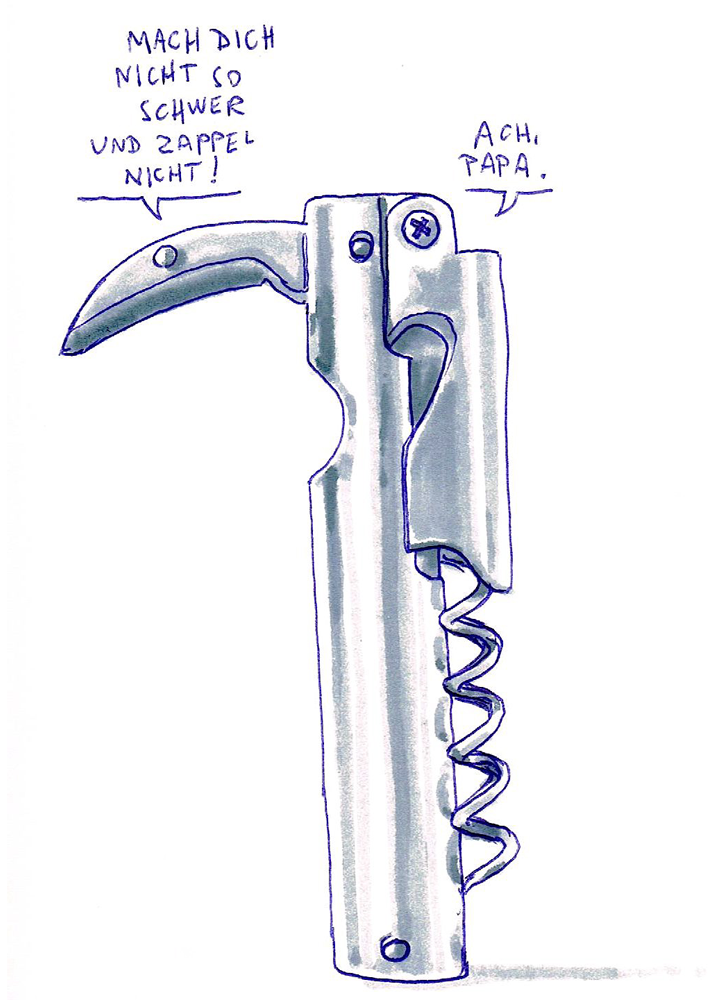
Take a look, try it out.
Isn't our brain a wonderful thing?
